
Chemically damaged hair can feel dry, rough, brittle, frizzy, tangled, or difficult to manage. If you regularly color, bleach, relax, perm, straighten, or otherwise chemically process your hair, your everyday routine may need more attention.
The good news is that learning how to care for chemically damaged hair does not mean you need a complicated 15-step routine. In many cases, the most helpful place to start is with consistent conditioning, gentler handling, less excessive heat, thoughtful styling, and protecting fragile-looking ends.
As a licensed master cosmetologist, I understand how frustrating it can be when hair that once felt soft and manageable begins feeling dry, fragile, or prone to breakage. I formulated Back2Naturalness Whipped Tallow Hair & Scalp Butter as a rich, natural hair-care option for people who want to add a conditioning and moisture-focused step to their routine.
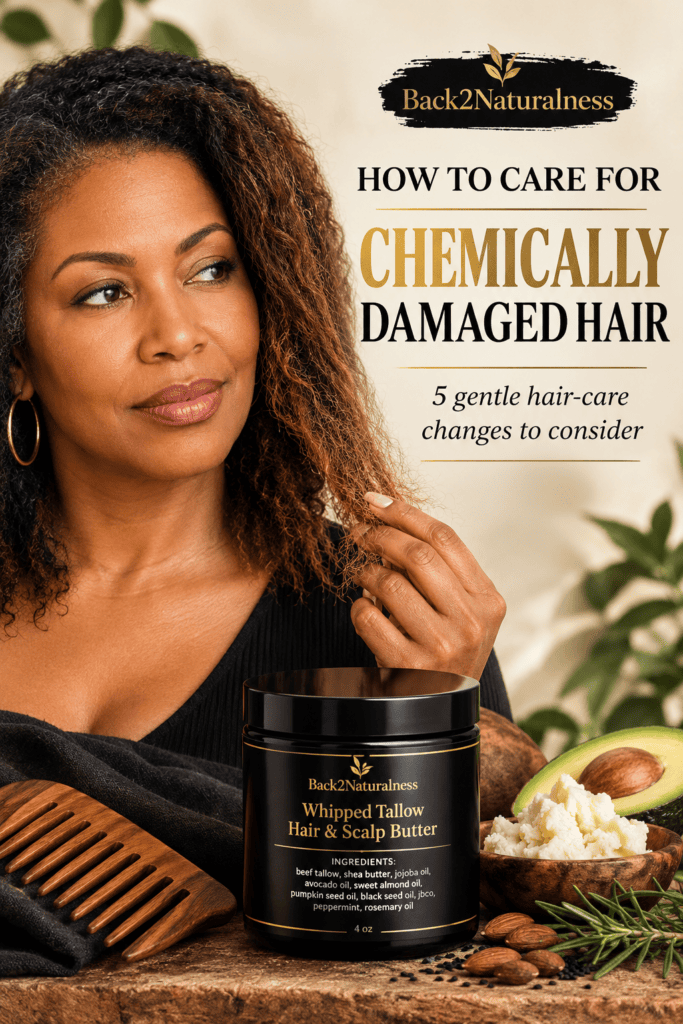
Quick Answer: How to Care for Chemically Damaged Hair
If your hair has been chemically treated and now feels dry, fragile, or difficult to manage, focus on these seven areas:
- Condition consistently.
- Handle your hair gently.
- Reduce excessive heat.
- Be thoughtful about additional chemical services.
- Protect dry-looking ends.
- Use moisture-focused products appropriately.
- Stay consistent instead of constantly changing products.
These steps are cosmetic hair-care strategies. They are not a medical treatment for hair damage or hair loss.
What Is Chemically Damaged Hair?
Chemically damaged hair is hair that has experienced damage associated with chemical processing such as coloring, bleaching, relaxing, or perming. Chemical services can change the structure and condition of the hair, and repeated processing may leave hair feeling dry or brittle.
The American Academy of Dermatology explains that coloring and perming can contribute to dry, brittle hair and provides recommendations for reducing additional damage.
Read the American Academy of Dermatology’s coloring and perming tips
Chemical processing is not automatically a problem. Millions of people color, relax, perm, or otherwise style their hair successfully. The important thing is understanding that chemically treated hair may require a more careful routine, especially when you begin noticing dryness, brittleness, tangling, or breakage.
Signs of Chemically Damaged Hair
| What You Notice | What Your Routine May Need |
|---|---|
| Dry or rough-feeling hair | More consistent conditioning |
| Frizz and difficult-to-manage strands | Gentler handling and conditioning |
| Frequent breakage | Less manipulation, heat, and tension |
| Dry-looking ends | Conditioning and protection |
| Tangling | Gentle detangling and appropriate conditioning |
7 Simple Steps for Chemically Damaged Hair Care
Think of chemically damaged hair care as a process of reducing unnecessary stress while giving your hair the conditioning, moisture, and protection it needs.
1. Chemically Damaged Hair Needs Consistent Conditioning
One of the first things to examine when caring for chemically damaged hair is your conditioning routine.
The American Academy of Dermatology recommends using conditioner after washing because conditioner can moisturize hair and make it easier to manage. The AAD also recommends choosing products based on your hair type.
See the American Academy of Dermatology’s healthy hair-care tips
If your hair is dry, curly, textured, long, color-treated, or chemically treated, you may need to pay particular attention to the lengths and ends of your hair.
What Does Conditioning Do for Chemically Damaged Hair?
Conditioning can help hair feel smoother, softer, and easier to detangle. For some people with dry, brittle, color-treated, permed, or chemically treated hair, a leave-in conditioning product can also be useful.
The American Academy of Dermatology notes that leave-in conditioners can be helpful for hair that is color-treated, permed, heat-styled, dry, brittle, tangled, or frizzy.
Learn about leave-in conditioners from the American Academy of Dermatology
MOISTURE CHECK
Dry + rough + difficult to detangle?
Take a closer look at whether your current routine provides enough conditioning for your hair type.
2. Handle Chemically Damaged Hair Gently
When people think about how to care for chemically damaged hair, they often immediately think about buying another product. But sometimes one of the most useful changes is changing how you handle your hair.
Rough brushing, aggressive detangling, pulling, tugging, and rough towel drying can add unnecessary mechanical stress.
The American Academy of Dermatology recommends gentle handling and explains that excessive brushing, rough drying, heat styling, and pulling can contribute to hair damage.
Read the AAD guide to hair styling without damage
Gentle Hair Handling Checklist
- Use a wide-tooth comb when appropriate for your hair texture.
- Start detangling from the ends and gradually work upward.
- Do not aggressively pull through knots.
- Avoid rough towel rubbing.
- Minimize unnecessary brushing.
- Be particularly gentle with fragile-looking ends.

3. Reduce Heat When Caring for Chemically Damaged Hair
If you already have chemically damaged hair, repeatedly exposing it to high heat may add another source of stress.
Blow dryers, flat irons, curling irons, hot combs, and other heated styling tools can contribute to hair damage. The AAD recommends limiting excessive heat and using lower heat settings when possible.
See dermatologists’ recommendations for styling hair without damage
Chemically Damaged Hair Heat Guide
| Current Habit | Gentler Alternative |
|---|---|
| High heat frequently | Use lower heat and less frequently |
| Frequent flat ironing | Include heat-free styling days |
| Long blow-drying sessions | Allow some air drying when practical |
| No heat protection | Use an appropriate heat-protective product |
4. Give Chemically Damaged Hair More Time Between Chemical Services
Another important part of chemically damaged hair care is being thoughtful about how frequently you chemically process your hair.
Coloring, bleaching, relaxing, and perming can all place stress on the hair. The American Academy of Dermatology recommends precautions with chemical services and explains that these treatments can contribute to dry and brittle hair.
Read the AAD’s tips for coloring and perming healthier-looking hair
Before Your Next Chemical Service, Ask Yourself:
- Does my hair currently feel unusually dry?
- Am I experiencing more breakage than normal?
- Have I recently colored, bleached, relaxed, or permed my hair?
- Am I combining multiple chemical services too close together?
- Could I give my hair more time between services?
If your hair feels unusually fragile, consider discussing its condition with a professional cosmetologist or stylist before your next chemical service.
5. Protect the Ends of Chemically Damaged Hair
The ends of your hair are the oldest portion of the strand. For someone with chemically damaged hair, the ends may be especially important to monitor because they can experience repeated friction, tangling, brushing, heat, and styling.
Simple End-Care Routine
1. CONDITION after cleansing.
2. DETANGLE gently.
3. MOISTURIZE dry-looking lengths and ends as needed.
4. PROTECT your hair during styling and sleep.
5. MINIMIZE unnecessary heat and manipulation.
6. Add a Rich Hair Butter to Your Chemically Damaged Hair Routine
A rich hair butter can be an option for people who prefer a more substantial conditioning product. The key is using an amount that works for your particular hair texture, density, and styling routine.
As a licensed master cosmetologist, I formulated Back2Naturalness Whipped Tallow Hair & Scalp Butter for people who want a rich, natural hair-care product that can be incorporated into a moisture-focused routine.
What’s Inside Back2Naturalness Whipped Tallow Hair & Scalp Butter?
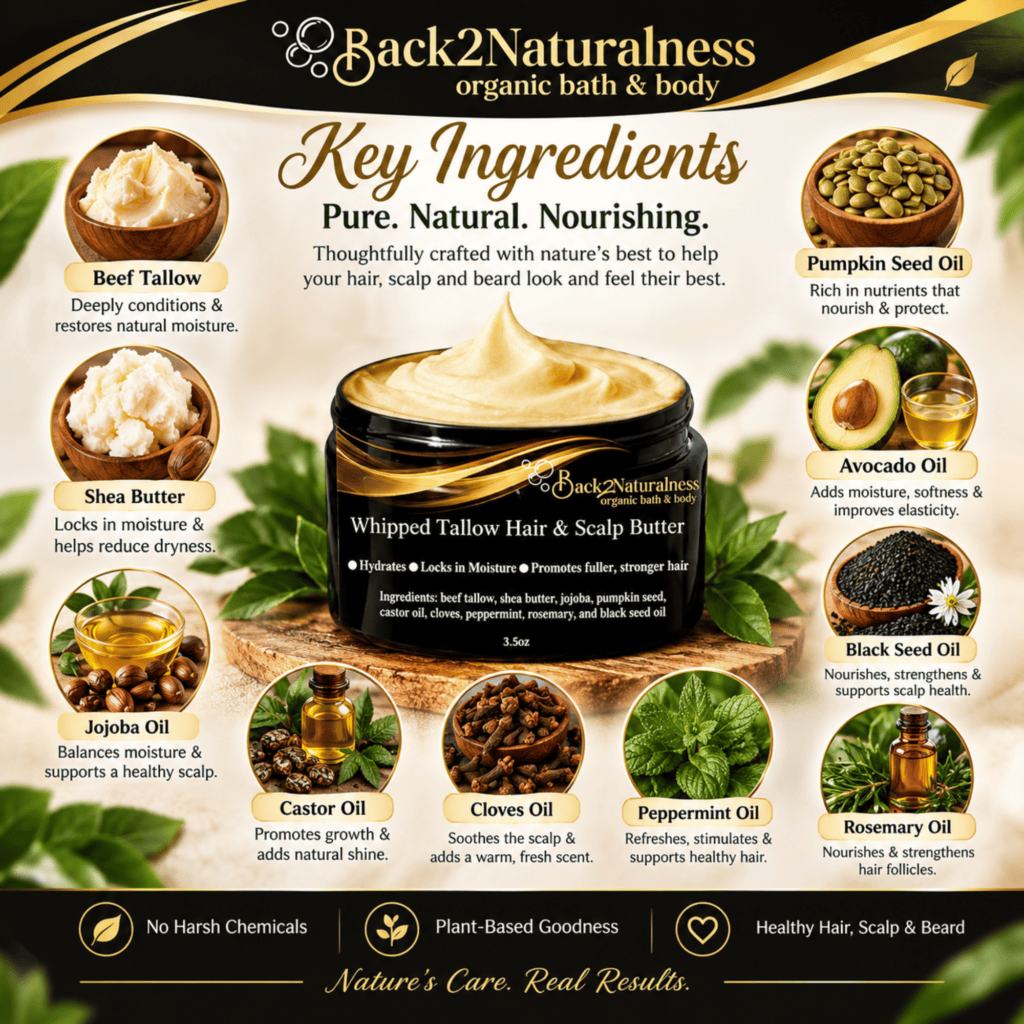
| Ingredient | Role in the Formula |
|---|---|
| Beef Tallow | Rich emollient base. |
| Shea Butter | Rich plant butter commonly used in hair and skin care. |
| Jojoba Oil | Botanical oil commonly used in hair-care formulations. |
| Avocado Oil | Botanical oil used in conditioning formulations. |
| Sweet Almond Oil | Conditioning botanical oil. |
| Pumpkin Seed Oil | Botanical oil included in the formula. |
| Black Seed Oil | Botanical oil used in natural beauty formulations. |
| Jamaican Black Castor Oil | Rich botanical oil commonly used in hair-care routines. |
| Peppermint Oil | Botanical oil included in the formula. |
| Rosemary Oil | Botanical oil included in the formula. |
Explore Back2Naturalness Whipped Tallow Hair & Scalp Butter →
How Much Hair Butter Should You Use?
Start small. A rich hair butter does not need to be applied heavily to be part of your routine.
THE START SMALL RULE
A little → distribute → assess → add only if needed.
Fine or lower-density hair may need less product, while thick, coarse, or highly textured hair may tolerate more. Let your hair’s response guide you.
Where Should You Apply Hair Butter?
If your main concern is dry-looking ends, start there rather than applying a large amount to your entire head.
Warm a small amount between your fingertips and distribute it through the areas that need additional conditioning. If you choose to use a rich butter on your scalp, use a small amount and monitor how your scalp responds.
This is important because some hair-care products containing oils can contribute to breakouts around the hairline or forehead in some people. The American Academy of Dermatology explains that this type of breakout can occur from hair-care products.
Learn how hair-care products can contribute to breakouts from the AAD
7. Build a Consistent Chemically Damaged Hair Care Routine
The final step is consistency.
You do not need a complicated routine filled with dozens of products. A manageable routine that you can actually maintain may be easier to follow than constantly switching between products.
Chemically Damaged Hair Routine Chart
| Routine Area | Focus |
|---|---|
| Cleanse | Clean your scalp according to your individual needs. |
| Condition | Improve softness and manageability. |
| Detangle | Reduce unnecessary pulling. |
| Moisturize | Add a suitable moisturizing product when needed. |
| Protect | Reduce excessive heat, friction, and tension. |
| Evaluate | Pay attention to how your hair responds. |
What Should You Avoid With Chemically Damaged Hair?
When you’re trying to improve the appearance and manageability of chemically damaged hair, reducing unnecessary stress can be just as important as choosing a product.
Chemically Damaged Hair: Habits to Reconsider
❌ Excessive heat styling
❌ Rough towel drying
❌ Aggressive detangling
❌ Constantly tight hairstyles
❌ Excessive brushing
❌ Frequent overlapping chemical services
❌ Using more product than your hair needs
❌ Constantly changing your routine
The AAD recommends reducing excessive heat, avoiding continuous tension, and taking precautions with chemical services to help prevent additional hair damage.
Read the AAD’s 10 hair-care habits that can damage hair
Chemically Damaged Hair vs. Dry Brittle Hair
Chemically damaged hair and dry brittle hair can overlap, but they are not necessarily the same thing.
Dryness, brittleness, and breakage can have multiple causes. Chemical processing is one possible contributor, while heat, mechanical stress, environmental exposure, styling habits, and individual hair characteristics can also influence how hair looks and feels.
That is why I recommend looking at your entire routine rather than expecting one product to solve every hair concern.
If you’re also dealing with dry, brittle-looking hair, read our related guide:
Dry Brittle Hair? 5 Things Your Hair May Need →
Chemically Damaged Hair: A Simple 5-Part Formula
MOISTURE + GENTLE CARE + PROTECTION + LESS STRESS + CONSISTENCY
This is a simple hair-care framework, not a scientific formula or guarantee of results.
When Should You See a Professional About Chemically Damaged Hair?
Cosmetic hair care has limits. If you notice persistent scalp irritation, significant thinning, bald spots, unusual shedding, or continuing breakage despite changing your routine, consider speaking with a board-certified dermatologist.
The American Academy of Dermatology recommends professional evaluation when hair concerns continue or when you are concerned about thinning or hair loss.
Read the AAD’s tips for managing hair loss and fragile hair
Important Reminder
A cosmetic hair-care product can support the appearance and manageability of your hair, but it cannot diagnose or treat an underlying medical condition.
Chemically Damaged Hair: Questions & Answers
Here are some common questions about caring for chemically treated, dry, brittle, or fragile-looking hair.
Can chemically damaged hair become healthy again?
Hair that has already been physically damaged cannot simply return to its original condition through a cosmetic product. However, you can change your routine to reduce additional damage and help existing hair look and feel more manageable. Conditioning, gentle handling, reduced heat, and thoughtful styling can all be part of a better routine.
What is the best treatment for chemically damaged hair?
There is no single best treatment for everyone. A good starting point is consistent conditioning, gentle handling, reduced heat, less tension, and thoughtful spacing between chemical services. A rich hair butter can be one cosmetic option for adding conditioning and moisture to a hair-care routine.
Is tallow good for chemically damaged hair?
Tallow can be used as a rich emollient ingredient in hair-care formulations. Back2Naturalness Whipped Tallow Hair & Scalp Butter combines beef tallow with shea butter, jojoba oil, avocado oil, sweet almond oil, pumpkin seed oil, black seed oil, Jamaican black castor oil, peppermint oil, and rosemary oil. It can be incorporated into a moisture-focused hair-care routine according to individual hair needs.
Can I use hair butter on chemically damaged hair?
Yes, a hair butter can be incorporated into a routine for some people with chemically treated, dry, or brittle-looking hair. Start with a small amount, particularly on the lengths and ends, and adjust according to how your hair responds.
How often should I use hair butter on chemically damaged hair?
There is no universal schedule. Hair texture, density, styling habits, and individual preferences differ. Start with a small amount and use it when your hair needs additional conditioning rather than automatically applying a large amount every day.
Should I stop coloring my hair if it is damaged?
Not necessarily, but you may want to give fragile hair more time between chemical services and discuss your hair’s condition with a professional before your next appointment. Chemical services can contribute to dryness and brittleness, so thoughtful scheduling matters.
See the AAD’s recommendations for coloring and perming
Does heat make chemically damaged hair worse?
Excessive heat can contribute to hair damage. If your hair is already fragile, consider reducing the frequency of heat styling and using lower heat settings when heat styling is necessary.
What should I do about dry brittle ends?
Focus on conditioning, gentle detangling, reducing heat and friction, and protecting your ends during styling. A small amount of a rich hair butter can also be used on dry-looking lengths and ends if your hair responds well to richer formulas.
Can chemically damaged hair cause breakage?
Chemical processing can contribute to hair damage and brittleness, while heat, tension, rough handling, and other styling practices can add additional stress. Reducing these sources of stress can be an important part of your routine.
Can I use Whipped Tallow Hair & Scalp Butter on my scalp?
If you choose to use a rich butter on your scalp, start with a very small amount and monitor how your scalp responds. Everyone’s scalp is different, and a rich product may not be appropriate for every person. If you experience irritation or unwanted bumps, discontinue use.
Can chemically damaged hair grow longer?
Hair growth and hair retention are different things. Your hair grows from the scalp, while the visible length of the hair shaft is the result of retaining the strands you already have. A gentle routine that reduces breakage can help you retain more of your existing length, but cosmetic products should not be presented as a guaranteed hair-growth treatment.
The Bottom Line: How to Care for Chemically Damaged Hair
Caring for chemically damaged hair does not have to be complicated. Start by looking at your entire routine rather than searching for one miracle product.
Condition consistently. Handle your hair gently. Reduce excessive heat. Be thoughtful about chemical services. Protect your ends. Use moisture-focused products appropriately. And give your routine time and consistency.
As a licensed master cosmetologist, I formulated Back2Naturalness Whipped Tallow Hair & Scalp Butter for people who want a rich, natural option to incorporate into their hair-care routine.
The formula combines beef tallow, shea butter, jojoba oil, avocado oil, sweet almond oil, pumpkin seed oil, black seed oil, Jamaican black castor oil, peppermint oil, and rosemary oil.
Looking for a Rich Natural Hair Butter?
Explore Back2Naturalness Whipped Tallow Hair & Scalp Butter and decide whether it fits your hair-care routine.
EXPLORE WHIPPED TALLOW HAIR & SCALP BUTTER
Save This Chemically Damaged Hair Guide
Know someone dealing with dry, brittle, chemically treated hair? Save this guide to Pinterest so you can come back to these tips later.
Save This Guide on Pinterest →
Disclaimer: This article provides general educational and cosmetic hair-care information and is not medical advice. Hair damage, breakage, thinning, and scalp concerns can have many causes. If you experience persistent scalp symptoms, significant hair loss, t
